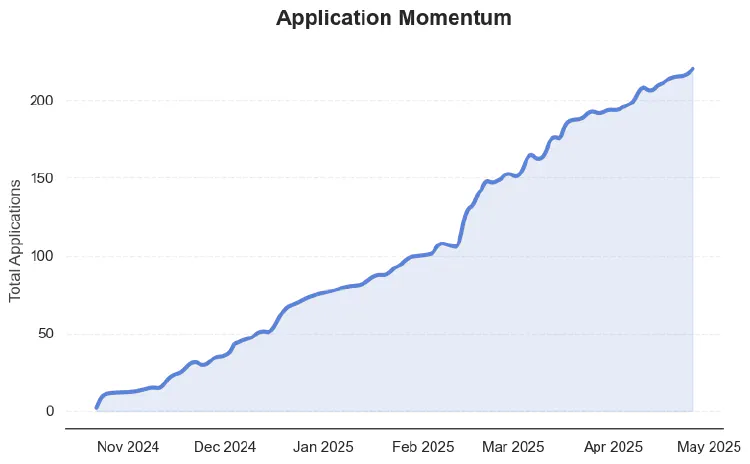
Last year I was out of work for 8 months. During that time I submitted 220 applications. Most went nowhere. The job I got? I thought I bombed. Here’s the story.
I was laid off from IBM in Oct 2024, and hired by the University of Texas at Austin in May 2025. I thought I’d take a minute to reflect on my process and share some numbers. This is not intended as advice, but while I was searching I was keenly interested in what was working for others, so I’m sharing with that in mind.
As soon as my employment with IBM was terminated, I filed for unemployment. This turned out to be very helpful for me. The money wasn’t enough to live on but absolutely helped. When you have no income everything helps. But the real benefit was that I needed to keep showing progress.
Motivation
Motivation to keep going during a job search is challenging. No replies from applications, ghosted by recruiters, and the rejections. Ouch the rejections. I stayed sane by meeting with friends for lunch/coffee when possible, and taking on personal projects. But if I stopped submitting applications I would lose unemployment benefits, each week I had to report the number of applications that I had completed. That weekly requirement was good accountability.
How I used AI
At first, I used AI to tailor every single resume. It felt efficient, until I accidentally sent a resume made for Company A to Company B. That mistake killed my candidacy instantly. After that I spent a week perfecting one resume and only customized the cover letters. Did this cost me opportunities? We’ll never know but probably. But it simplified my application workflow and I was able to keep track of what was sent to whom.
Here’s where AI actually helped, interview practice. It had been a few years since my last interview so I needed to brush up. I’d prompt with a job description, ask for interview questions, then have it grade my responses. Eventually I’d set a timer and use dictation, talking through my answers felt more realistic. And I do think this helped with easing my nerves during interviews.
What actually worked
I began via applications through LinkedIn and Indeed. One click applications felt efficient. A month in I realized that my response rate was terrible. So I shifted to applying directly on company websites where possible, and networking. In hindsight it’s notable that only one of my 22 interviews came from an easy apply application. If you’re only using those platforms, you may be missing opportunities.
Side note: Somewhere along the way I learned of services that will auto-submit hundreds (thousands) of applications per week for a fee. I don’t think much of this, you’re basically spamming recruiters. Don’t do that.
I also began trying to make connections within each company via my LinkedIn network. Despite only making connections at a handful of companies, the majority of my 22 first interviews came from those networked applications. For the companies that I did establish connections with, I was able to get a heads up on roles before they were posted. One recruiter liked me and called me more than once encouraging me to apply (which I did). Keeping motivation up through this process is a challenge, and these prompts were wind in my sails. If you’re not sure where to start, this guide is helpful.
I found it difficult to read my own performance in interviews. There were several that I thought I did well in, only to never hear another word. I practiced interviewing quite a bit. I thought I absolutely bombed my interview for the role that I accepted. It was a 30 minute meeting and 10 minutes in the interviewer said “ok thanks we’ll let you know”. I kept us going for another 5 minutes by asking a few questions. But when I got back to my car I thought there was no way I’d ever hear from them again. And then I got the job. So I’ve learned to not place too much value on my own judgment of my performance.
The final tally
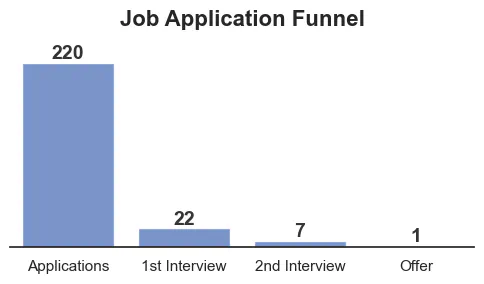
All told, I submitted 220 applications over an 8 month period. From that, I had 22 first interviews, 7 second interviews and 1 offer.
220 applications. 22 first interviews. 7 second rounds. 1 offer. And the biggest lesson? I was wrong about which interview would change everything. If you’re in the thick of a job search, don’t worry about grading yourself. Keep going, and you may be surprised.